
Professional dog grooming scissors
Choose grooming scissors for the cutting task and your dominant hand. Straight or curved blade shape is a separate consideration from thinning, chunking or blending function. Length, teeth, handle design and right- or left-handed construction work together to determine suitability.
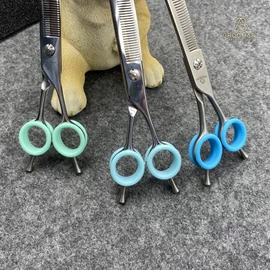

Jargem IVY curved chunker dog grooming scissors 35T – 7″ (17.5 cm)


Jargem PHILIP straight chunker dog grooming scissors 26T – 8″ (20 cm)

Jargem NEO straight thinning dog grooming scissors 45T – 6.5″ (16.5 cm)


Jargem POLLY micro-serrated straight dog grooming scissors – 7″ (18 cm)

Jargem LYRA super-light curved dog grooming scissors – 6″ (15.5 cm), green
Jargem LYRA super-light curved dog grooming scissors – 6″ (15.5 cm), purple
Blade shape and cutting function: examples
Jargem KIRA curved scissors for shaping curves and Jargem AXEL curved chunkers for texturing illustrate two different functions. Hydra Academy Set includes straight, curved and thinning scissors. Tooth count alone is not a thinning percentage; compare the cutting function and the full blade geometry together.
How to choose dog grooming scissors
Choose scissors by cutting technique, dog size and coat type, as well as your own hand position. A well-planned salon set combines several tools: one builds the shape, another blends transitions and a third finishes detailed areas.
Scissor types and their jobs
- Straight scissors: for clean lines and larger flat areas.
- Curved scissors: for paws, heads and rounded body contours.
- Blenders: for soft, natural transitions and reducing visible cut marks.
- Thinning scissors: for controlled reduction of coat bulk.
- Chunkers: for faster texturing and a natural-looking finish.
- Left-handed scissors: with true left-handed blade orientation and ergonomics.
Size, fit and maintenance
A longer blade can cover large areas faster, while a shorter blade can offer more control for details. The handle should not force the wrist, and the finger holes should fit securely. Remove coat residue after work, keep the blades dry and oil them as directed by the manufacturer. If scissors push, fold or chew the coat, contact us about scissor care.
Blade shape, function and handedness
Compare straight or curved blade shape, thinning, chunking or blending function, and right- or left-handed construction as separate characteristics. Tooth count alone does not establish how much coat is removed.
Can curved scissors also be chunkers or blending scissors?
Yes, where the manufacturer specifies the model that way. Curvature describes blade shape; chunking or blending describes the cutting role. Use the individual model’s description to establish its function.